My friend told me that when you buy something in a foreign place with your card, and the machine offers you to pay on the local currency or on your currency, you should choose the LOCAL one. Basically when you do that, your card is the one doing the exchange, while if you choose your currency, they do the exchange and you pay that on your currency. Their exchange is likely to be worse than your card's exchange.
So, I just tested this. I purchased a flight ticket on Cathay's website and the default was HKD. The total was 2638 HKD. They give you the option to pay with USD, but when I selected that it said 348 USD. Google exchange rate was giving actually 338 USD. So, I did what my friend suggested and picked HKD. Later checking my credit card bill, sure enough, I had actually paid 338 USD! :)
Great!
Showing posts with label financial. Show all posts
Showing posts with label financial. Show all posts
Friday, June 28, 2019

Tuesday, February 14, 2017
Health care and retirement coverage in Spain
This post is mostly looking into the situation of Spaniards living abroad but eventually planning to go back to Spain.
For healthcare covered by taxpayer pocket, the governing law is really wide and covers almost everybody. Some that fall outside could be a resident that makes more than 100k Euros but doesn't pay Social Security (which includes Health Care). Or a Spaniard that is not resident. Nevertheless, if the Spaniard is visiting, he is still covered as long as nothing else does:
I guess that integrates de-facto such a Spaniard in the coverage, although there is a doubt about treating not urgent cases ("go back home and take care of it there").
How about retirement?
Wikipedia, as usual, is a good reference but I think only shows the old regime (which somehow you can choose, if you want?). In the new regulations, it seems that to compute the base of what you get paid you use the last 25 years of data. The formula is tricky and it never gives 100% of your pay (you divide by 350, but there are only 300 months in 25 years). But you can actually start getting paid after paying only 15 years. The kick is that then you get only 50% of the base. The percent increases by 0.19% every month, the first 248 months and then by 0.18% the rest, to cap at 100% after 300 months (25 years). Notice that if you only worked 15 out of 25 years, the first 10 are included on the base but at much lower rate (not zero, though, but minimum salary type stuff). So, if it was zero it would be 50% of 15/25 = 30%, but it'll be a bit higher (as again, it is not zero...) on one side, but lower as you actually owe to compute the base by dividing by 350, not 300 (25 years).
I guess I can decide soon if it is worth... How much is the payment?
A friend suggested to sign up as self-employee (autonomo). To compute how much you would pay, you would choose your salary from a range (between 893 and 3642), and then apply a rate (29.8%). So, say that you want to have the maximum salary at retirement but start paying when you are 52 (15 years before the 67 years of retirement age). You would pick the 3642x29.8%=1085 Euro/month. Nevertheless, you have to make sure you are paying that by the time you reach 47 or otherwise the maximum is limited to 1900. Anyhow, if I am thinking this right, notice that you pay about 1/3 of what you claim to make (which becomes the base eventually). So, when you start getting paid back (after retirement) you actually make about the same per month (in the scenario where you only paid for 15 years). Looks a bit like a break even deal (as you don't know if you are going to live past 67+15=82 years).
The kicker is that my friend was considering doing that while he was actually working on a foreign country (non-EU) so, probably was not legal (?).
Cheers!
For healthcare covered by taxpayer pocket, the governing law is really wide and covers almost everybody. Some that fall outside could be a resident that makes more than 100k Euros but doesn't pay Social Security (which includes Health Care). Or a Spaniard that is not resident. Nevertheless, if the Spaniard is visiting, he is still covered as long as nothing else does:
- "Los trabajadores por cuenta ajena españoles de origen que no residan en Estados miembros de la Unión Europea, ni en Estados parte del Acuerdo sobre el Espacio Económico Europeo ni en Suiza que se desplacen temporalmente a España tendrán derecho a la asistencia sanitaria en España, con cargo a fondos públicos, a través del Sistema Nacional de Salud cuando, de acuerdo con las disposiciones de Seguridad Social española, las del Estado de procedencia o las normas o Convenios internacionales de Seguridad Social establecidos al efecto, no tuvieran prevista esta cobertura."
I guess that integrates de-facto such a Spaniard in the coverage, although there is a doubt about treating not urgent cases ("go back home and take care of it there").
How about retirement?
Wikipedia, as usual, is a good reference but I think only shows the old regime (which somehow you can choose, if you want?). In the new regulations, it seems that to compute the base of what you get paid you use the last 25 years of data. The formula is tricky and it never gives 100% of your pay (you divide by 350, but there are only 300 months in 25 years). But you can actually start getting paid after paying only 15 years. The kick is that then you get only 50% of the base. The percent increases by 0.19% every month, the first 248 months and then by 0.18% the rest, to cap at 100% after 300 months (25 years). Notice that if you only worked 15 out of 25 years, the first 10 are included on the base but at much lower rate (not zero, though, but minimum salary type stuff). So, if it was zero it would be 50% of 15/25 = 30%, but it'll be a bit higher (as again, it is not zero...) on one side, but lower as you actually owe to compute the base by dividing by 350, not 300 (25 years).
I guess I can decide soon if it is worth... How much is the payment?
A friend suggested to sign up as self-employee (autonomo). To compute how much you would pay, you would choose your salary from a range (between 893 and 3642), and then apply a rate (29.8%). So, say that you want to have the maximum salary at retirement but start paying when you are 52 (15 years before the 67 years of retirement age). You would pick the 3642x29.8%=1085 Euro/month. Nevertheless, you have to make sure you are paying that by the time you reach 47 or otherwise the maximum is limited to 1900. Anyhow, if I am thinking this right, notice that you pay about 1/3 of what you claim to make (which becomes the base eventually). So, when you start getting paid back (after retirement) you actually make about the same per month (in the scenario where you only paid for 15 years). Looks a bit like a break even deal (as you don't know if you are going to live past 67+15=82 years).
The kicker is that my friend was considering doing that while he was actually working on a foreign country (non-EU) so, probably was not legal (?).
Cheers!
Tuesday, March 17, 2015
Lowest Cost Wire Transfers
Directly to the answer... (some savings comparisons below, FYI).

I am kind of surprised to see this today, as I had read somewhere 0.75%, but will investigate later... Still way better than others I saw before... Also, I am pretty sure it is lower (0.5%) for other currencies but no worries, they’ll show it to you before anything... As I said, everything is very transparent. After taking the $85, they would convert the rest at today's rate of 1.0593 $/Euro (1/0.9440) which is exactly what Yahoo displays at this time:
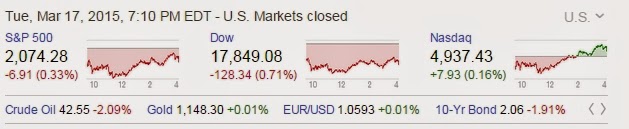
So, basically they are giving you a rate 0.5-0.85% worse than the number displayed in Yahoo, which as I said, it’s very competitive.
Note: there is one more transfer fee which is the one your bank will charge you to send your money to a local US bank account on the name of TransferWise (Wells Fargo). My bank charges me $20. So, you should add that, but yeah... And the number is fix, so, the higher the dollar transfer, the lower percent that it represents...
So, that's it... but if you want to keep reading about a quick comparison when I tried to send money through my bank to Europe, here it goes...
Basically there would be two costs. The transfer itself and the conversion to Euros from dollars, which can be done at origin or destination. Rate (yahoo) at the time was 1Euro=$1.135 more or less. I tried several banks (Texans Credit Union, BBVA, Chase) and the best was 1.18!! That is 4% and I believe included both commissions. Can't really remember the details... Anyhow, you can always ask them yourself ahead of anything. They may tell you that they can't tell what the exchange rate will be because it will depend on when it actually happens in the next days. If so, ask for the exchange rate "today" just for comparison...
Cheers!
The website name is TransferWise. If you click on this link (https://transferwise.com/u/b9886f) they should give you commission free up to $4k in your first transfer. For full disclosure, every 3 of those I get $150 in my account,
but seriously, keep reading :) And if you don't want to use the link, don't :)
Heads up, the signing process is a bit annoying because they
need to ID you properly (to avoid money laundering, tax evasion…). Nothing too
bad, all online, but they ask you for some pic of your driver license or something like
that… Can't remember. Done in 10 minutes, though.
Other than that, the service is truly excellent. They give you
immediate email feedback on every step of your transfer and usually exceed
expectations on schedules. So far, 2 day transfers although they usually cover themselves and give you a worst forecast. The whole process is ultra transparent and they also reply very timely emails.
The best thing (who would care otherwise about anything else) are the rates. Way better than anything else I found (but hey, please comment if you got something better :) ). For instance, to transfer $10k
to Euro today, they would take $85 commission (which is basically 0.85%):
I am kind of surprised to see this today, as I had read somewhere 0.75%, but will investigate later... Still way better than others I saw before... Also, I am pretty sure it is lower (0.5%) for other currencies but no worries, they’ll show it to you before anything... As I said, everything is very transparent. After taking the $85, they would convert the rest at today's rate of 1.0593 $/Euro (1/0.9440) which is exactly what Yahoo displays at this time:
So, basically they are giving you a rate 0.5-0.85% worse than the number displayed in Yahoo, which as I said, it’s very competitive.
Note: there is one more transfer fee which is the one your bank will charge you to send your money to a local US bank account on the name of TransferWise (Wells Fargo). My bank charges me $20. So, you should add that, but yeah... And the number is fix, so, the higher the dollar transfer, the lower percent that it represents...
So, that's it... but if you want to keep reading about a quick comparison when I tried to send money through my bank to Europe, here it goes...
Basically there would be two costs. The transfer itself and the conversion to Euros from dollars, which can be done at origin or destination. Rate (yahoo) at the time was 1Euro=$1.135 more or less. I tried several banks (Texans Credit Union, BBVA, Chase) and the best was 1.18!! That is 4% and I believe included both commissions. Can't really remember the details... Anyhow, you can always ask them yourself ahead of anything. They may tell you that they can't tell what the exchange rate will be because it will depend on when it actually happens in the next days. If so, ask for the exchange rate "today" just for comparison...
Cheers!
Sunday, March 31, 2013
How to deal with RSUs
RSU stands for Restricted Stock Units.
Tons of details here.
To the point... Imagine I got 167 Awards/Units Granted. At the vesting date, employer uses 52 to pay the tax and I get to keep the rest, 115 "total shares available (delivered)". In governments eyes, you got 167*$32.18 (share price at vesting)=$5374.06. So, this shows up in your W-2. The brokerage already took some of those shares and sold them to pay for the tax (52*$32.18=$1673.36) and the rest (115) are now real shares at the account, which figure like if they were bought that day (remember this day for the time you sell them). Basically, this is called a Sell to Cover. Probably best would be Same Day Sale but anyhow:
http://thefinancebuff.com/restricted-stock-units-rsu-tax.html
Basically this is like the company giving you the cash at the date of the vesting, so, ordinary income. As this happens in the brokerage that your company has chosen, the whole earnings/taxes are already included in the W-2. So, you got to do nothing, not even enter a fake line with buy/sell for the same price! You should see in your W-2, under the box 12, a "V" case declaring the total amount (all the shares x price at vesting):
http://thefinancebuff.com/restricted-stock-units-rsu-sales-and.html
http://thefinancebuff.com/rsu-sell-to-cover-deconstructed.html
Of course, keep track of the purchase price. Now it is like any other stock purchased at that price and date. You'll have to pay/get tax/loss depending on when you sell and the price at the time. Notice that according to this one can't use 83b trick for these.
Tons of details here.
To the point... Imagine I got 167 Awards/Units Granted. At the vesting date, employer uses 52 to pay the tax and I get to keep the rest, 115 "total shares available (delivered)". In governments eyes, you got 167*$32.18 (share price at vesting)=$5374.06. So, this shows up in your W-2. The brokerage already took some of those shares and sold them to pay for the tax (52*$32.18=$1673.36) and the rest (115) are now real shares at the account, which figure like if they were bought that day (remember this day for the time you sell them). Basically, this is called a Sell to Cover. Probably best would be Same Day Sale but anyhow:
http://thefinancebuff.com/restricted-stock-units-rsu-tax.html
Basically this is like the company giving you the cash at the date of the vesting, so, ordinary income. As this happens in the brokerage that your company has chosen, the whole earnings/taxes are already included in the W-2. So, you got to do nothing, not even enter a fake line with buy/sell for the same price! You should see in your W-2, under the box 12, a "V" case declaring the total amount (all the shares x price at vesting):
http://thefinancebuff.com/restricted-stock-units-rsu-sales-and.html
http://thefinancebuff.com/rsu-sell-to-cover-deconstructed.html
Of course, keep track of the purchase price. Now it is like any other stock purchased at that price and date. You'll have to pay/get tax/loss depending on when you sell and the price at the time. Notice that according to this one can't use 83b trick for these.
Sunday, April 17, 2011
IRS Penalty for underpayment
So, one day before paying my taxes, I realized I had to pay a bit more than expected and afraid of penalties, I checked the rules. Quite frigging cryptic the first time you read them, but here is an example for future reference. Say that your tax withholding (what you had paid so far in taxes) was $8000 but that what you should have paid was $10000. The IRS wants you to pay penalty if you make a mistake by "too much".
Disclaimer: I have no clue about tax reporting. Follow the above at your own risk. Just trying to help :)
- The first cut is an absolute number. Basically, something that says "don't worry if you just underpaid by this much...". And that limit is set at $1000. So, with an underpayment of $2000, we are way past that.
- The 2nd is if you should have imagined that you had to pay more than you paid. I.e., with what you had made, should you have realized that your error was too big... For that there are 2 cuts:
- The first is very similar to the "first cut" but instead of absolute quantity, it's a relative. Here they are saying: "if you paid in a range of 90% of what you were supposed to pay, you are fine". 8k is less than than 90% of 10k (9k), so, we can't say that we are fine... The error is considered "too big" by the IRS
- The second is saying "you even paid less than what you paid in 2009 moron!". So, say that you paid in 2009 $9500 of taxes (check line 60 of the 1040). This year you paid only $8k. I think you got no excuse. But if last year you had paid only $7k of taxes, then you would be fine. In other words, if you pay in withholdings along the year more than the total tax you paid the previous year, you are fine. You got an "excuse" :)
Disclaimer: I have no clue about tax reporting. Follow the above at your own risk. Just trying to help :)
Subscribe to:
Posts (Atom)